
Relief from Chronic Reflux & Internal Hernias
Advanced robotic surgery to repair defects in the diaphragm, restore proper anatomy, and permanently resolve GERD and swallowing difficulties.
When the Stomach Moves Up
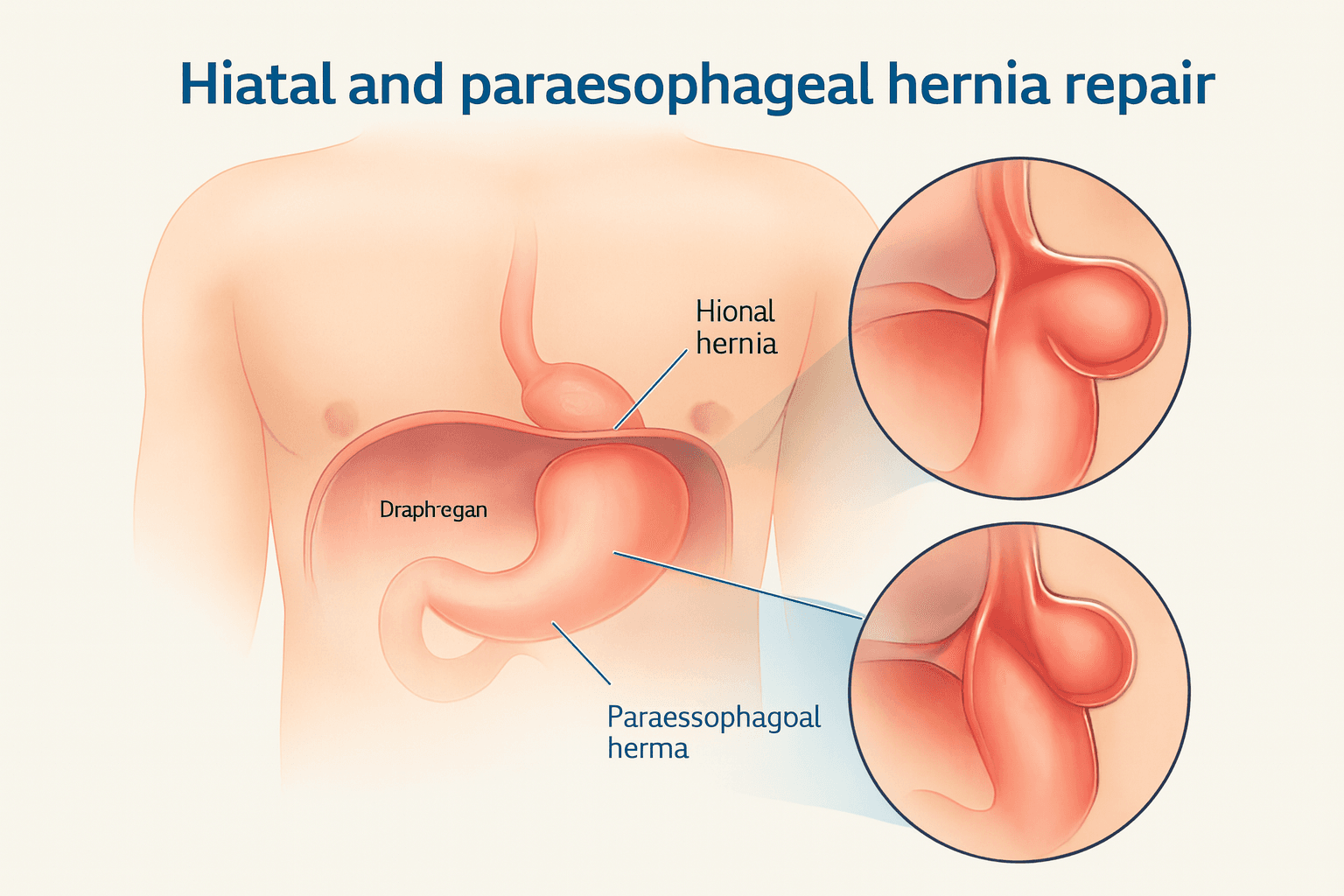
Unlike a visible bulge on your stomach (like an umbilical hernia), a Hiatal Hernia happens internally. It occurs when the upper part of your stomach pushes through an opening in the diaphragm (the hiatus) and into your chest cavity.
While small "sliding" hiatal hernias are common and often treated with medication, Paraesophageal Hernias are more serious. In these cases, a larger portion of the stomach becomes stuck in the chest next to the esophagus, which can be dangerous if left untreated.
More Than Just Heartburn
Many patients live with symptoms for years, masking them with antacids without realizing the root structural cause.
Common Symptoms:
- Severe GERD: Acid reflux that doesn't respond well to medication.
- Dysphagia: Difficulty swallowing or feeling like food is "stuck" in the chest.
- Shortness of Breath: Large hernias can press on the lungs, especially after eating.
- Chest Pain: Often mistaken for heart issues (always rule out heart problems first).
- Early Satiety: Feeling full after eating only a small amount of food.
The Danger of Waiting:
Paraesophageal hernias carry a risk of volvulus (twisting of the stomach) or incarceration (stomach getting trapped and losing blood supply). These are surgical emergencies. Elective repair prevents these life-threatening complications.
The Gold Standard: Robotic Hiatal Hernia Repair
Repairing a hernia deep inside the chest cavity requires exceptional precision. Dr. Abidali and Dr. Qureshi utilize the da Vinci® Robotic Surgical System to perform this procedure minimally invasively.
Reduction
We gently pull the stomach back down from the chest into the abdomen where it belongs.
Sac Excision
We remove the hernia "sac" from the chest to prevent recurrence.
Crural Repair
We suture the hole in the diaphragm (the hiatus) closed to prevent the stomach from slipping up again. Often, we reinforce this with a specialized mesh.
Fundoplication
To prevent future reflux, we often perform a "wrap" (Nissen or Toupet fundoplication), wrapping the top of the stomach around the lower esophagus to create a new, functional valve.
Why We Use the Robot
Better Vision
The 3D camera allows us to see the delicate nerves (vagus nerve) and blood vessels around the esophagus clearly.
Deep Access
The robot's arms can reach deep into the hiatus (upper abdomen/chest) more easily than straight laparoscopic tools.
Faster Recovery
Tiny incisions mean less pain and a quicker return to a normal diet compared to open surgery.
Life After Surgery
Recovery from hiatal hernia repair involves a specific dietary progression to allow the swelling in the esophagus to heal.
Hospital Stay:
Most patients stay 1 night for monitoring.
The "Mushy" Diet:
You will likely be on a liquid/soft food diet for 2–4 weeks post-surgery. This ensures food passes easily while the swelling goes down.
Long-Term Results:
Most patients experience immediate relief from acid reflux and can stop taking daily PPI medications (like Omeprazole) shortly after surgery.
Experts in Foregut Surgery
Hiatal hernia repair is complex "foregut" surgery. It requires a surgeon who understands the delicate anatomy of the diaphragm and esophagus. Dr. Abidali's advanced training in abdominal transplant surgery gives him unique skills in dissecting and handling these complex internal structures safely and effectively.
Frequently Asked Questions
Not always. However, if you have a large hiatal hernia (paraesophageal) or if your medications are no longer working to control your reflux, surgery is the only way to fix the mechanical problem.
Recurrence is possible, but our advanced techniques—including complete sac excision and mesh reinforcement—are designed to minimize this risk. We also advise on weight management to reduce pressure on the diaphragm.
This is the "wrap" part of the surgery. We wrap the upper part of the stomach 360 degrees around the lower esophagus. This acts as a one-way valve, letting food down but stopping acid from splashing up.